One person still manages the list
Transfer noticing and planning with the task. A reminder from a partner is still household work.
A fair split accounts for effort, frequency, timing, and the mental work of noticing. Use this five-step method with a partner, roommates, or a family household, then adjust it against real life.
Ten tasks each can still be wildly unfair. One list may contain daily cooking, scheduling, and a deep bathroom clean; the other may contain occasional bins and quick errands. Task count erases time, recurrence, unpleasantness, and planning.
A fair arrangement also does not have to be identical. One person can prefer cooking and another laundry. The test is whether both people understand the whole workload, can influence the agreement, and feel the typical week is sustainable.
Walk room by room and list outcomes: a usable kitchen, clean clothes, stocked household supplies, bills paid, appointments remembered. Include noticing and planning when those are meaningful parts of the work.
Do this: Write the list before assigning a single name.
Estimate time, physical or emotional unpleasantness, how often it returns, and whether it must happen in a narrow window. A ten-minute job every day may outweigh a one-hour job once a month.
Do this: Use a simple 1–5 effort scale and a real frequency.
Ownership includes noticing, planning, and finishing the agreed outcome. If one person still has to remind the assigned person, the management work never actually moved.
Do this: Define what done means and who owns the next occurrence.
Rotate recurring jobs that are interchangeable and broadly disliked. Keep stable ownership where skill, preference, schedule, or accessibility makes it sensible, then balance effort with other work.
Do this: Choose the rotation order and the date it advances.
Look at the coming week, trade around travel or late shifts, and fix schedules that were wrong. Review the system, not each other’s character.
Do this: Stop after ten minutes unless the agreement itself needs work.
This example converts monthly work to a rough weekly average. The points are conversation aids, not a claim that household labor can be measured perfectly.
| Outcome | Owner | Frequency | Effort | Weekly average |
|---|---|---|---|---|
| Cook and reset kitchen | Alex | 4× weekly | 3 | 12 |
| Bathroom clean | Sam | Weekly | 4 | 4 |
| Laundry, fold, put away | Sam | 2× weekly | 3 | 6 |
| Plan and buy groceries | Alex | Weekly | 4 | 4 |
| Floors | Sam | Weekly | 3 | 3 |
| Bills and shared supplies | Alex | Weekly avg. | 3 | 3 |
| Approximate weekly total | Alex 19 · Sam 13 | |||
The first draft is not balanced: Alex’s cooking frequency dominates. They could rotate one cooking night, move groceries to Sam, or decide that another non-listed responsibility closes the gap. The point of the table is to make that adjustment visible.
Transfer noticing and planning with the task. A reminder from a partner is still household work.
Write the outcome once: surfaces cleared, sink scrubbed, floor swept, supplies replaced.
Use the frequency the home actually needs, not the aspirational version nobody follows.
Trade or reschedule deliberately. Do not build a shame backlog that makes restarting harder.
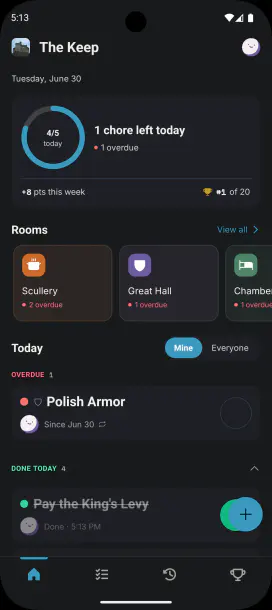
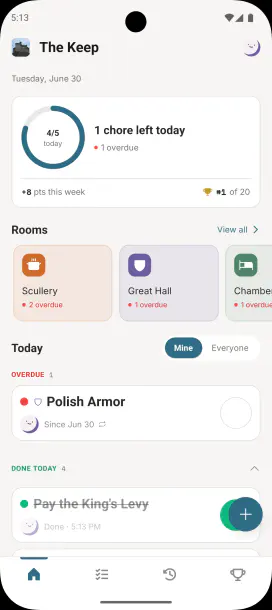
Start on paper with the printable roommate chore chart, or put the agreed tasks into a shared app. ChoreKeep is designed to carry room organization, assignments, repeating schedules, rotation, reminders, effort levels, and completion history for roommates, couples, and family households.
No public release date is announced yet. We’ll send one email when ChoreKeep hits the stores — no newsletter, no countdown.